Welcome and Acknowledgements
“Good morning everyone.
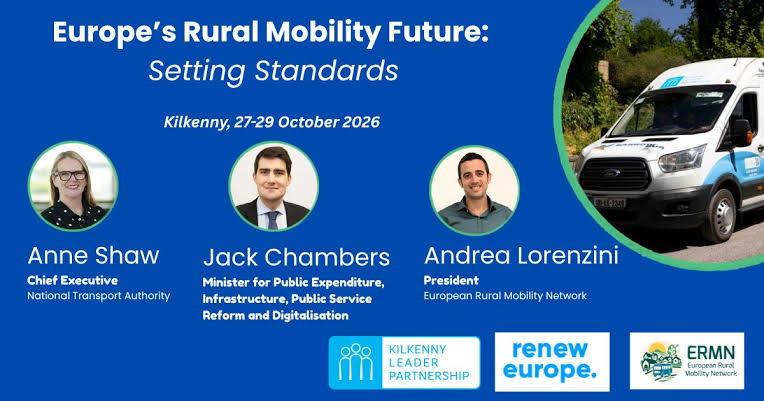
It is a real pleasure to be here in Kilkenny today, and to join colleagues and friends from across Ireland and Europe for this important discussion on the future of rural mobility.
I would like to begin by thanking Cynthia Ní Mhurchú, the European Rural Mobility Network, Kilkenny LEADER Partnership, and everyone involved in organising this conference.
Bringing together policymakers, transport providers, researchers, community leaders and practitioners from across Europe creates a valuable opportunity to learn from one another and to share ideas about how we can better connect our communities.
Rural Mobility is About People
The theme of this conference is rural mobility. However, I believe that what we are really talking about today is people.
We are talking about how people access opportunity. We are talking about whether a young person can get to education or training. We are talking about whether someone can travel to work, attend a medical appointment, participate in community life, visit friends and family, or simply remain connected to the people and places that matter most to them.
Ultimately, we are talking about people’s ability to participate fully in society and in the communities where they live.
The Strength of Rural Communities
One of the great strengths of rural Ireland is the strength of its communities.
Across the country there are communities that are vibrant, resilient and deeply connected. People look out for one another. Local organisations, sports clubs, schools, businesses and community groups play a vital role in bringing people together and creating a strong sense of place.
But even the strongest communities need connections.
Communities thrive when people can reach jobs, education, healthcare and social opportunities. They thrive when businesses can attract customers and employees. They thrive when young people can see a future for themselves locally and when older people can remain active, independent and connected to their communities.
Why Transport Matters
That is why transport matters.
Not because of buses or timetables in themselves, but because transport enables all of those other things. Good transport links support stronger communities, greater inclusion and a better quality of life.
These challenges are not unique to Ireland. Across Europe, countries are asking many of the same questions. How do we ensure that people living in rural areas have meaningful access to services and opportunities? How do we reduce social isolation? How do we support sustainable travel choices? And how do we ensure that people living outside our major urban centres have access to the same opportunities as those living within them? These are precisely the questions that make this conference both timely and important.
Connecting Ireland: A Community Development Programme
 At the National Transport Authority, these questions have been central to our work over the past number of years.
As many of you will know, we have been delivering the Connecting Ireland Rural Mobility Plan, one of the most significant expansions of rural public transport ever undertaken in Ireland.
While it is often described as a transport programme, I think it is equally a programme about community development.
Its purpose is to connect people with opportunity and communities with one another, while ensuring that where somebody lives does not determine their ability to access education, employment, healthcare or social participation.
Launch of the Connecting Ireland 2025 Review
Today is a particularly appropriate day to be having this discussion because this morning the National Transport Authority is publishing the Connecting Ireland 2025 Review.
We deliberately held the publication of this review until today because the findings speak directly to the themes being discussed throughout this conference.
The review demonstrates the progress that has been made, but more importantly it demonstrates what is possible when investment is focused on connecting people and communities.
Evidence of Progress and Growing Demand
The results are encouraging.
In 2025 alone, more than 11 million passenger journeys were made on Connecting Ireland services. Since 2019, patronage on these services has increased by 225%, demonstrating the very real demand that exists for public transport in rural Ireland when services are available, reliable and accessible.
During 2025, we introduced or enhanced 36 services across the country, including 10 entirely new routes. These improvements connected an additional 31 towns and villages to the public transport network and improved access to public transport for approximately 206,000 people.
Taken together, these figures tell an important story.
They tell us that when we provide services, people use them, that rural communities want better connectivity. And they tell us that public transport can play a central role in supporting vibrant and sustainable rural communities.
The People Behind the Numbers
But what matters most are not the numbers themselves. What matters is what sits behind those numbers.
Every passenger journey represents a real person.
A student travelling to college.
A worker getting to their job.
Someone attending a healthcare appointment.
A shopper travelling into town.
A family member visiting a loved one.
Every journey represents an opportunity that might otherwise have been difficult or impossible to access.
A Kilkenny Success Story
The review includes the story of a passenger here in County Kilkenny who benefited from the introduction of Route 891. Before the service was introduced, public transport was simply not available for many everyday journeys. The passenger described the route as a “gamechanger”, allowing access to appointments, shopping and essential services without having to depend on others for transport.
For me, that captures exactly why this work matters.
Defining Success in Rural Mobility
Success is not measured solely by passenger numbers.
Success is measured by whether people feel more connected, whether communities feel more accessible and whether people have more opportunities for greater independence.
Setting Mobility Standards for the Future
As we look ahead, it is fitting that this conference focuses on the idea of mobility standards.
The concept is both ambitious and important.
Initiatives such as Connecting Ireland and the Smart DRT pilots also help us answer one of the key questions at the heart of this conference.
At its heart lies a simple question: what level of mobility should every citizen reasonably expect, regardless of where they live?
Across Europe, different countries and regions are approaching that question in different ways. Some have introduced minimum service levels. Others have adopted policy frameworks designed to improve accessibility and connectivity. All are seeking to address the same fundamental challenge: how do we ensure that geography does not become a barrier to opportunity?
Challenges and Opportunities Ahead
In Ireland, we are still on that journey.
We know there is more to do.
We know there are communities that still need better services.
We know there are people who continue to experience transport disadvantage.
And we know that meeting our social, economic and climate objectives will require continued investment and continued ambition.
But I believe we also have reason to be optimistic.
Lessons from Connecting Ireland
The experience of Connecting Ireland has demonstrated that progress is possible.
It has shown that rural public transport can be attractive, effective and transformative.
It has shown that relatively modest interventions can have a significant impact on people’s lives.
And it has shown that when communities, local authorities, operators and policymakers work together, meaningful change can be achieved.
The Importance of Partnership
That partnership is critically important. The future of rural mobility cannot be delivered by transport authorities alone. It requires collaboration between national government, local authorities, transport operators, community organisations, researchers and policymakers.
Most importantly, it requires listening to the people who use these services and understanding the unique needs of the communities they serve.
Creating Thriving Rural Communities
Because successful rural mobility is never just about transport.
It is about creating places where people can thrive.
It is about supporting local economies.
It is about tackling social isolation.
It is about enabling independence.
And it is about ensuring that rural communities remain vibrant, sustainable and attractive places to live.
A Shared Vision for the Future
As we begin today’s discussions, I hope we keep that broader purpose firmly in mind.
Because while we will talk about standards, policy frameworks, service design and funding models, the ultimate goal is much simpler.
The goal is to ensure that people can live full and connected lives.
The goal is to ensure that communities can continue to flourish.
And the goal is to ensure that no matter where someone lives, they have access to the opportunities and connections that allow them to participate fully in society.
That is a goal worth pursuing.
It is a goal that unites all of us in this room.
And it is a goal that will help shape the future of mobility across Ireland and across Europe.
Thank you, and I wish you a very productive and successful conference.”