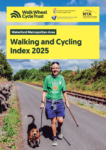
Walking, wheeling and cycling take up to 15,000 cars off the road each day in the Waterford Metropolitan Area, according to the 2025 Walking and Cycling Index, published in partnership with Walk Wheel Cycle Trust and the National Transport Authority.
Key findings from the Walking and Cycling Index
Key findings from the Walking and Cycling Index include:
Walk, Wheel, Cycle Participation Rates:
- 45% of adult residents walk 5 or more days a week, 68% use a car 5 or more days a week and 3% of adults cycle at least once a week.
Economic, Health and Environmental Benefits of People who Walk, Wheel or Cycle:
- Every day those who walk, wheel or cycle for non-leisure trips when they could have used a car take up to 15,000 cars off the road in the Waterford Metropolitan Area. If all of these cars were in a traffic jam it would tail back 70 kilometres.
- Residents walking, wheeling and cycling create an annual economic benefit for individuals and the Waterford Metropolitan Area of €67 million.
- Walking and cycling improve public health in the Waterford Metropolitan Area, preventing 149 long-term health conditions and saving the HSE €1.8 million equivalent to the cost of over 31,000 GP appointments.
- Those walking and cycling instead of driving, save greenhouse gas emissions equivalent to 34,000 flights from Dublin Airport to London Heathrow Airport.
- There is a €1.62 net economic benefit for each km cycled instead of driven and €1.14 net economic benefit for each km walked instead of driven.
Public Attitudes of the Waterford Metropolitan Area towards Walking, Wheeling and Cycling:
- 45% of adult residents walk 5 or more days a week, 68% use a car 5 or more days a week while 12% of adults cycle at least once a week.
- 51% of adult residents want to walk or wheel more and 32% want to cycle more.
- 86% of residents support building cycle tracks physically separated from traffic and pedestrians, even where that means less room for other traffic, up from 76% in 2023.
- 35% of women say they do not cycle but would like to – up from 19% in 2023.
- 90% of residents support reducing speed limits, improving crossing points and protected cycle paths in school neighbourhoods.
- 86% of residents supporting building more cycle tracks physically separated from traffic and pedestrians, even where that means less room for other traffic, up from 76% in 2023.

Background Documents
- For a summary of the overall Walking and Cycling Index methodology
- For details on the residents survey
- Sustrans Data Dashboard:
- Sustrans has interactive dashboards available that can be used to explore the data, see:
- https://www.sustrans.org.uk/the-walking-and-cycling-index/walking-and-cycling-index-data-tool
- Previous Reports