Rationale and Motivation
The purpose of this report is to assess and quantify the economic benefits that have arisen from National Transport Authority’s (NTA) Active Travel Investment Programme since 2021 and are expected to continue until 2030. The analysis presents a national and macro-level assessment rather than an evaluation of individual projects. Fundamentally, this report aims to demonstrate the economic value of sustained investment in active travel infrastructure, reflecting both the progress achieved to date and the continued development of a comprehensive active travel network. It makes the case for maintaining and securing funding over the coming years through the Active Travel Investment Programme.
NTA’s Active Travel Investment Programme
From 2021 to 2025, the NTA delivered almost 950 kilometres in active travel infrastructure, along with bridges, junction upgrades, school zones and other non-route investments. As active travel emerges as a growing sector, many local authorities require standalone active travel units. This institutional presence is supported by the Programme, which directly supported 275 active travel staff within all 31 local authorities in 2025.
The next five to ten years will be important in safeguarding and building upon the progress already made. Continued funding will allow the Programme to mature, enabling behavioural change to deepen, active travel network connections to strengthen and the full societal benefits of active travel to be realised. As planned allocations are nominal, an inflation gap of €330 million for the next 5 year
s is anticipated, which is expected to reduce the number of active travel projects delivered under the Programme.
Active Travel Benefits
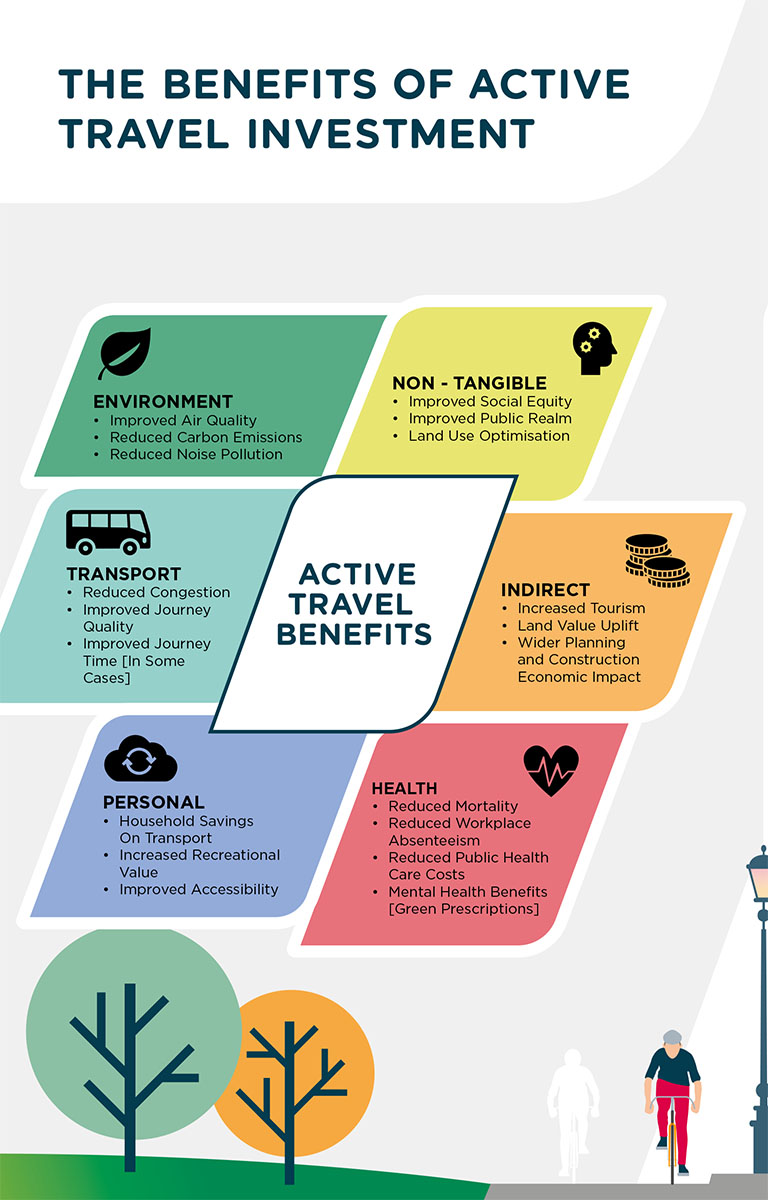
The active travel benefits are divided across five main categories, of which avoided health costs are one.
- Enviromental
- Transport
- Personal
- Health
- indirect